by welluehealth | Feb 15, 2022 | Respiratory
What your blood oxygen level shows
Your red blood cells are like vehicles. Each can carry up to four oxygen molecules across your body, getting them to places like your heart and brain. Your body’s vital systems need a normal percentage of oxygen inside your blood at all times, known as your oxygen saturation. However, sometimes your blood can get either too much or too little oxygen, and in these cases, there can be serious health consequences.
People with chronic health conditions many need to monitor their blood oxygen level. This includes asthma, heart disease, and chronic obstructive pulmonary disease (COPD).
In these cases, monitoring your blood oxygen level can help determine if treatments are working, or if they should be adjusted.
Keep reading to learn where your blood oxygen level should be, what symptoms you may experience if your level is off, and what happens next.
Where your blood oxygen level should fall
A measurement of your blood oxygen is called your oxygen saturation level. In medical shorthand, you may hear it called a PaO2 when using a blood gas and an O2 sat (SpO2) when using a pulse ox. These guidelines will help you understand what your result might mean:
Normal Blood Oxygen Levels
Older adults typically have lower oxygen saturation levels than younger adults. For example, someone older than 70 years of age may have an oxygen saturation level of about 95%, which is an acceptable level.
It is important to note that the oxygen saturation level varies considerably based on a person’s state of health. Thus, it is important to understand both baseline readings and underlying physiology associated with certain conditions to interpret oxygen saturation levels and changes in these levels.
- People who are obese and/or have conditions such as lung and cardiovascular diseases, emphysema, chronic obstructive pulmonary disease, congenital heart disease and sleep apnea tend to have lower oxygen saturation levels.
- Smoking can influence the accuracy of pulse oximetry in which the the SpO2 is low or falsely high depending on whether hypercapnia is present. With hypercapnia, it is difficult for the pulse oximeter to differentiate oxygen in the blood from carbon monoxide (caused by smoking).
- Oxygen saturation levels may decrease slightly when a person is talking.
- Oxygen saturation may remain normal (e.g., 97% and higher) for people with anemia. However, this may not indicate adequate oxygenation because there are less hemoglobin to carry an adequate supply of oxygen for people who have anemia. The inadequate supply of oxygen may be more prominent during activity for people with anemia.
- Falsely low oxygen saturation levels may be associated with hypothermia, decreased peripheral perfusion, and cold extremities. In these cases, an ear lobe pulse oximeter device or arterial blood gases would provide a more accurate oxygen saturation level. However, arterial blood gases are usually only taken in critical care or emergency settings.
Points to Consider
For medical purposes, a normal blood oxygen saturation rate is often considered between 95% and 100%.In practice, the SpO2 range of 92–100% is generally acceptable for most clients. Some experts have suggested that a SpO2 level of at least 90% will prevent hypoxic tissue injury and ensure client safety (Beasley, et al., 2016).
Low Blood Oxygen Levels
The medical definition of a low blood oxygen rate is any percentage below 90% oxygen saturation. Oxygen saturation below 90% is very concerning and indicates an emergency. Call 911 immediately if you or someone you know experiences such a low blood oxygen level.
When Low Oxygen Saturation Affects Your Brain
By the time your oxygen saturation has fallen to between 80% and 85%, your brain may be affected by the lack of oxygen. You may also experience vision changes.
What happens if your oxygen level is too low
When your blood oxygen level goes outside the typical range, you may begin experiencing symptoms.
This includes:
shortness of breath
chest pain
confusion
headache
rapid heartbeat
Cyanosis
The first visible symptoms of low blood oxygen, cyanosis causes a blue tinge to develop on your skin, particularly around your mouth and lips and beneath your fingernail matrix. This change occurs when your blood oxygen saturation reaches approximately 67%.
Cyanosis is considered an emergency. If you’re experiencing symptoms, you should seek immediate medical attention. Cyanosis can lead to respiratory failure, which can be life-threatening.
What causes blood oxygen levels to be low
Conditions that can negatively affect your blood oxygen level include:
COPD, including chronic bronchitis and emphysema
acute respiratory distress syndrome
asthma
collapsed lung
anemia
congenital heart defects
heart disease
pulmonary embolism
These conditions may prevent your lungs from adequately inhaling oxygen-containing air and exhaling carbon dioxide. Likewise, blood disorders and problems with your circulatory system may prevent your blood from picking up oxygen and transporting it throughout your body.
Any of these problems or disorders can lead to declining oxygen saturation levels. As your oxygen levels fall, you may begin experiencing symptoms of hypoxemia.
People who smoke may have an inaccurately high pulse ox reading. Smoking causes carbon monoxide to build up in your blood. A pulse ox can’t tell the difference between this other type of gas and oxygen.
If you smoke and need to know your blood oxygen level, an ABG may be the only way to receive an accurate reading.
How to adjust your blood oxygen level
If your blood oxygen level is too low, you may need to boost your oxygen saturation. This is often done with supplemental oxygen.
Home supplemental oxygen is considered a medication, and your doctor must prescribe it. It’s important to follow your doctor’s specific advice on how home oxygen should be used to avoid complications. Your health insurance may cover the expense.
We are dedicated to developing products with medical-grade accuracy but consumer friendly, finding an easier and more modern way to track your wellness, we believe you can get peace of mind to live a healthier and longer life.

by welluehealth | Jan 18, 2022 | Respiratory, Reviews
A number of companies are looking beyond the wrist at the next frontier in wearable technology. Few people know that the finger can provide a useful snapshot of a person’s overall health. This is because it contains arteries that can be sensed by finger-worn devices to capture physiological data such as your heart rate and blood oxygen.
Slim and sleek, smart rings are generating lots of interest. Particularly amongst people who are after something that is useful, as well as lightweight and fashionable. The big brands, such as Apple, Fitbit, and Garmin, are yet to enter this area. But there are a few other players with interesting offerings.
One of these is Wellue. Their FDA-registered O2Ring continuously monitors your blood oxygen (SpO2), heart rate, and movement with clinical-grade accuracy. Slip it onto your thumb or index finger and it will do the rest. You can view data in real-time on the device itself, or sync the ring with the app or the accompanying PC/Mac software for detailed analysis and reports on trends.
Typically retailing for $169 on getwellue.com , the O2Ring is more expensive than a typical fingertip blood oxygen monitor. Is it worth the extra price? I set out over the past week to find out.
Wellue O2Ring review: Design & hardware
- Feels solidly built – rubberised design
- More about functionality than fashion
- Large, easy to read display
- 12-16 day battery life
Look & feel
Despite the name, the Wellue O2ring is not a ring in the classical sense. The device is made of soft silicone that has a rubberized feel to it. It is also larger than a typical ring so is more about function than style. But it is smaller and much less cumbersome than fingertip blood oxygen monitors which it is meant to replace.
The actual size of the device comes in at 4 x 3 x 3.5cm (L x W x H) and weight at 15 grams. It fits fingers that measure between 50 and 82mm. The rubberized band stretches so can expand for those with large fingers.
While it is not fancy, the whole thing does feel solidly built. A large screen sits on top which is easy to read thanks to its size.
On one side of the display is a touch key that you can use to wake up the screen and cycle through time, heart rate/oxygen level readings. There’s no power button. As soon as you slip on the ring it will turn on the sensor and the screen will spring to life. When you remove the ring, it will switch off automatically after a few seconds. I really liked this, as most of my other devices require powering on and off. The touch key is also very responsive.
You are meant to wear the O2Ring on your thumb finger. If that feels too tight, the other option is to use the index finger. I found the band approach to be much more comfortable than fingertip alternatives as it does not get in the way of anything. You can type and do pretty much anything you want while wearing the ring.
To properly test it out, for a week I wore the Wellue O2Ring every night during sleep. With all the typical tossing and turning it stayed in place and never felt in danger of slipping off. The rounded corners on the device mean that it does not snag on the bed sheets or pillows. In fact, the ring is so comfortable, I would wake up in the morning forgetting it is even on.
The only part of the design I am a bit cautious about is the flexible tip at the end of the silicon band. It seems a bit flimsy. I am not sure if it might break at some point with long-term use.
Unlike some other smart rings, this device is primarily meant for use at home or in healthcare facilities. The bulkiness of O2Ring means it is something you would probably not want to wear in outdoor environments anyway. You could if you wanted to. But blood oxygen readings are best taken while at rest or sleep so there would be little point in taking measurements in those conditions.
Wellue says the device is designed to give medically accurate readings during sleep when you are sitting somewhere or walking slowly. Some of their customers are professional pilots. They use the O2Ring to monitor their blood oxygen when flying planes.
The device has an IP24 rating for dust and water resistance. So you should not take a shower or bath with it, but you’ll probably be ok to wear it in the rain.
Under the hood
The technology that is used by Wellue O2ring is something called transmissive oximetry. This is trusted and used in hospitals and clinics. Smartwatches use reflective technology which is not seen as accurate.
With transmissive oximetry, a device passes two wavelengths of light through a thin part of the body to a photodetector. It then measures the changing absorbance at each of the wavelengths. Fingertips are perfect for such measurements as they have higher blood flow rates than other tissues. Hence the accuracy of the O2Ring and traditional clip-on fingertip oximeters.
The O2ring has built-in memory which enables it to work independently without a phone. There are 4 small memory cards built-in. Each can store about 10 hours of data.
This means you do need to sync with the app from time to time. So if you track sleep each night, after four or five nights you’ll need to fire up the app. If you don’t, the oldest recording will be deleted when the memory is full. Async is done automatically when connected via Bluetooth 4.0 to the smartphone app or computer software.
Apart from accuracy, what distinguishes the O2Ring from other such devices is the sampling rate. Oxygen levels, pulse rate, and motion data are captured at 1-second intervals. For those with medical conditions such as sleep apnea, the high sampling rate will be very important.
Battery life
As far as the all-important battery life, the oxygen ring has an advertised running time of between 12 and 16 hours on a single charge. Wellue says this is enough for two nights. In practice, though, I found that it was best to charge it after a full night’s sleep. I tend to sleep at least 8 hours per night and it definitely wouldn’t last me a full two nights.
Charging is done via a micro-USB cord. Unfortunately, there is no progress bar or percent charged on the display, so you will need to leave it on until the display turns off. It can take more than an hour to go from zero to full so it is not that quick.
The battery inside the Wellue O2Ring is similar to a coin cell for watches. So theoretically, you could replace it yourself if needed, or ask a repairman to do it. But the battery should last a few years so there probably wouldn’t be any need for that.
Wellue O2Ring review: Functionality
- Clinical-grade data, FDA registered for accuracy
- Choice of smartphone app or PC/Mac software
- Abnormal SpO2 and heart rate alerts
- Export high-resolution oxymetry reports to share with doctor
Setup and first use
For me, a highlight of this product is that it is incredibly easy to set up and just as easy to use. Start off by downloading the ViHealth app to your iPhone or Android device. Open it and create an account.
Slip your finger in O2Ring (or plug it into the charger) to switch it on and the app will find it and ask if you want to pair. Click on the picture of the ring and you’re done. From that point on it will link up automatically whenever the ring is switched on and the app is open. You can also use the app in offline mode to review data when the ring is off.
At this point, you might want to tweak a few options. Go to the “Settings” tab in the app where you will have the option to connect with Apple Health and where you’ll be able to turn on the heart rate and oxygenation alarms. This will also allow you to set up the high and low thresholds for each.
The O2Ring vibrates to alert the wearer if he or she has approached the preset limits. The idea is that this will warn you of heart abnormalities or hypoxic events so that you can take a break to recover. So, for example, if your oxygen level dips below the configured threshold during sleep, the vibration will wake you up so that you can adjust your sleep position.
For those that suffer from sleep apnea, this is a feature that cheap oxygen monitors simply do not have. So this feature alone justifies the higher price point of the Wellue O2Ring as compared to such devices.
The discreet vibration also helps your partner sleep better. Think of it as a vibrating smartphone. Something like this is great for meetings and noisy environments. Mind you, there’s no built-in speaker in the ring. However, the mobile app can sound audio alarms if that is your preference. You can even use both at the same time, the vibration alarm on the ring and the sound alarm on the phone.
I do feel, though, there is a missed opportunity that could be fixed with a firmware update. Considering the vibration functionality is already there along with a clock, it would be nice if the O2Ring could act as a morning wake-up alarm.
Lots of informative data in the smartphone app
You can use the ring itself for real-time blood oxygen and heart rate readings. Once you slip the device on it will automatically start to capture the measurements for a minute or so before shutting off the display so you can sleep. Dead simple. The real-time data can also be seen in the dashboard of the app.
I found the Perfusion Index (PI) to be a nice feature. Similar to an indication of the strength of a cell phone signal, it quantifies the quality of the pulse reading. This can vary depending on lots of factors such as the way you wear the ring, physiological conditions, skin temperature, and more. You can use it to assess whether you are wearing the device correctly. As long as PI is green you are good to go.
In the morning, you take off the ring, and the display will briefly turn on and start a count-down from 10 to 0 and then a “SAVING” and “END” message. After that, you can turn on your phone, open the app and allow it to sync.
Blood oxygen measurements appear to be accurate when compared with a traditional oximeter. That’s to be expected considering Wellue has secured FDA approval for the device. Plus measurements are captured each second and displayed in four-second intervals in the app. Much more useful than Apple Health which only shows SpO2 data in 10-minute intervals.
The “History” tab in the app shows you a timeline of all your measurements. What I didn’t like is that each time you remove the ring, it saves the session as a separate one. So if you take the ring off in the middle of the night and put it back on, two data sets will be created. So in that sense, it can get a bit messy.
Each individual session shows a wealth of data. There is a handy O2 score bar that quantifies your oxygen shortage during sleep. It combines frequency, duration, and depth of oxygen drops. In my case, I was typically at 9.8 and 9.9 which is considered to be excellent. If the Score turns yellow or red, Wellue suggests you speak to your doctor for advice. To make this easier, the O2Ring can create a SpO2 report in PDF format that you can email to your doctor.
Other data shows your average pulse rate for the session, average SpO2, the number of drops over 4%, lowest SpO2, and more. All very useful stuff that goes into more detail as far as blood oxygen than any other device I’ve come across. Nothing really out there allows you to create four-second interval, high-resolution oximetry reports that can be shared at the click of a button.
There’s also a PC, MAC app that you can optionally use
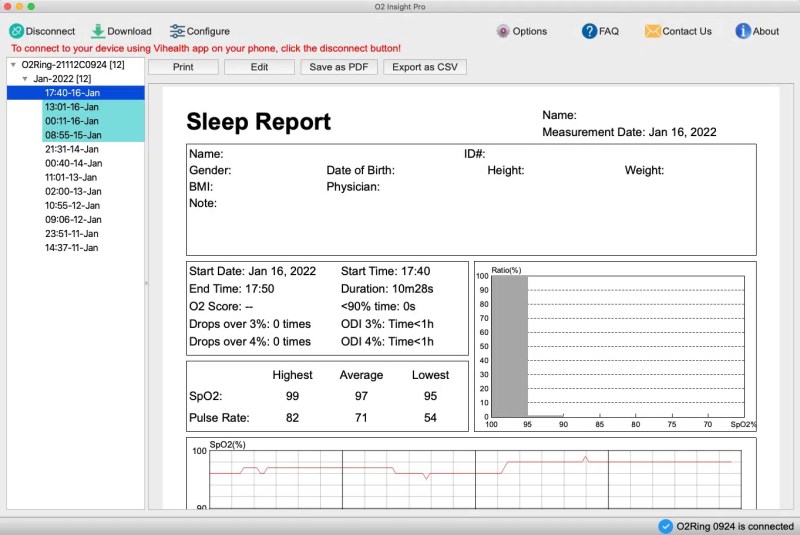
I also liked the fact that you have the option of installing PC or Mac software called O2 Insight Pro. Simply download it from the Wellue website.
It works exactly the same way as the smartphone app but everything is displayed on the large screen format that is easier to read. You’ll have no trouble detecting in detail the hourly graphs – it is comparable to an actual sleep study report.
Wellue O2Ring review: The bottom line, is it worth it?
The Wellue O2Ring is a very useful product. But it is not for everyone. The device is primarily designed for people who need to track their oxygen levels in detail, especially those who have or suspect they have sleep apnea or another medical problem. If you’ve recently tested positive for Covid-19 this ring might give you peace of mind.
The device predominantly does one thing and it does it well – it tracks your blood oxygen in one-second intervals with medical-grade accuracy. Other stats that you’ll get are heart rate and body movement. The thing will also buzz you into alertness if you are experiencing low oxygen levels or irregular heart rates. For those that suffer from sleep conditions, it could be a lifesaver. Shift your position and the buzzing will stop.
The ring is quite big in size so it is not something you would want to wear around the clock. But for measurements at home, in the office, or overnight it is quite useful. The device is also well made and comfortable to wear, in my case on my thumb.
Typically retailing for $169 on getwellue.com, the O2Ring is expensive if all you need are ad-hoc blood oxygen and heart rate readings. A typical fingertip pulse oximeter is a much cheaper option. But if you need overnight monitoring with alarms and long-term tracking then it is probably the best option out there. For some, it might become their most important piece of jewelry.
We are dedicated to developing products with medical-grade accuracy but consumer friendly, finding an easier and more modern way to track your wellness, we believe you can get peace of mind to live a healthier and longer life.

by welluehealth | Dec 24, 2021 | Respiratory, Reviews
I really don’t even know where to start with this little gadget. Hands down this is the best pulse oxygen monitor on the market that I have found.
Pros:
- Alarms- Low Oxygen, High and Low Pulse
- Reports
- Bluetooth connected Phone App
- Spot Check Rates While Active
Cons:
- Not Waterproof (probably not something easily done either)
- Price (a little on the high side but well worth it)
- Battery Life (approx 12 hours per charge)
Many consumer-grade pulse oximeters have a hard time getting a reading while you are active. Forget smartwatches, they require you to remain still while they check your oxygen saturation too. This is of no benefit to people with heart or lung disease that need to spot check while active and resting.
While the price tag may seem a little high at $165 let me tell you why it’s worth every penny. Especially with Christmas around the corner, this might be the perfect gift for someone you love who is chronically ill. Personally, if you have it in your budget to buy 2, I would highly recommend doing so especially if the person is on oxygen 24/7. Let me explain why.
Whenever I don’t wear my O2ring, I almost always regret it. The reason is, frankly, I am a dumbass that rarely listens to my body’s warning whistles until it’s to the point of no return. This little device has kept me from going past the point of no return many times since getting it.
Usually, I don’t realize there is something wrong with my oxygen until I have that horrible low oxygen headache. Which feels like someone took a blender to my brain. No alarm bells go off when I am getting more short of breath because I am always short of breath. Even as the headache is building, my internal alarm bells fail to sound the warning. This O2 ring can literally save you from all the headaches low oxygen saturation causes your body.
I live in a house with critters of all kinds. If it isn’t my husband or kids accidentally disconnecting my oxygen, it’s one of the four-legged kids. Or it’s a crack in the line that is making it so my oxygen flow is reduced. One time, this ring alerted me to my oxygen concentrator failing as the compressor was dying and my oxygen flow dropped.
Yes, this ring alerts you not only when your oxygen is dropping but heart rate increase and drop as well. It has several levels of vibration intensity that you can control. You can also custom set your thresholds for your oxygen and heart rate in the phone app.
Several weeks ago my oxygen kept falling and my heart rate kept rising. I couldn’t figure out why for the life of me. To top it off I wasn’t feeling well so I knew something was wrong. However, my line was connected and the tubing was new. So I just kept hitting the ignore.
Over the next few hours, I started feeling even worse and my alarms kept going off. This time I listened to the monitor and decided to check my flow rate was on my concentrator. This is usually set to 4 LPM. My concentrator was barely registering 1 LPM. At first, I assumed a dog bumped into it and dropped my flow rate down. But when I tried turning it up nothing happened. The next thing I knew, the ear-piercing alarm from my concentrator was going off too. For several hours this little device was trying to tell me something was wrong, I just wasn’t listening.
Had I listened to my O2 Ring when it first started alerting me of the problems I would’ve gotten my concentrator to my supplier during normal business hours instead of relying on their emergency service?
Another time when moving from house to vehicle, from concentrator to tank, I forgot to connect the tubing to the tank or didn’t secure it tight enough. I turned the tank on but somehow the O2 line wasn’t connected. Within a mile down the road, my O2 ring was vibrating. My son immediately checked my tank and noted the detached tubing. I was able to thwart a severe headache because I was wearing this ring.
I decided to take this ring to our local hospital’s Cardio-Pulmonary Rehab to let them try it out for a few weeks. I wanted to get the opinion of respiratory therapists who could run this unit through testing along with their units. This also allowed other patients to try it out to get even more thoughts and opinions. Just like me, everyone loved it. The RTS gave it a 9/10!
If you need a pulse ox this is the best one I have found on the market. If cost is a concern they do make another similar unit. It just doesn’t have all the bells and whistles of this unit but you should check it out below.
Please note, there are no affiliate links. I do not write these reviews to make money on your clicks. I write to educate and help people make informed purchases.
and
https://getwellue.com/pages/wearo2-wearable-pulse-oximeter (I have not tested this unit). This just measures O2 according to the comparison chart. Although images and descriptions show it does both pulse and O2, this unit is also waterproof! It is also documented as lighter, has a longer battery life, and is $65.00 cheaper.
We are dedicated to developing products with medical-grade accuracy but consumer friendly, finding an easier and more modern way to track your wellness, we believe you can get peace of mind to live a healthier and longer life.