– by Dr. Nigel Minihane, member of the Royal College of Physicians
Case
A 68-year-old man presented to his general practitioner with a 24-hour history of constant, centralised abdominal pain in the absence of pyrexia or other symptoms of sepsis.
On examination, he was tender in the right hypochondrium with no clinical evidence of liver enlargement.
Right subcostal POC EagleView ultrasound nicely demonstrated the presence of a gallstone in a contracted gallbladder with an associated acoustic shadow.
The patient was able to return home with an oral antibiotic cover and will be referred for a surgical opinion.
Conclusion
The ability to rule in a suspected clinical diagnosis increases diagnostic accuracy for generalist physicians.
We are dedicated to developing products with medical-grade accuracy but consumer friendly, finding an easier and more modern way to track your wellness, we believe you can get peace of mind to live a healthier and longer life.
– by Naroopa N, Registered Diagnostic Medical Sonographer From USA
Case
The patient is a 70-year-old woman. The patient is having right leg swelling and pain in the upper leg medial area. Ultrasound scan is performed using the EagleView probe. The deep femoral artery and vein are observed in the sagittal plane clearly. Upon scanning the patient to rule out DVT (deep vein thrombosis) the deep veins are clearly observed and close with compression, as shown below.
Color doppler is applied and demonstrated a beautiful doppler flow in the deep veins and the deep arteries with pulsed wave option. Pulsed wave shows a clear triphasic wave form in the femoral artery.
Upon augmentation, the femoral vein is showing filling in blue doppler color and the difference in the waveform is clearly displayed when augmentation occurs.
Conclusion
Upon scanning the area of pain; two inguinal lymph nodes areas seen on the right side. Impression: There was no evidence of deep vein thrombus or arterial obstruction. The patient has numerous inguinal lymph nodes that were measured and will be monitored.
We are dedicated to developing products with medical-grade accuracy but consumer friendly, finding an easier and more modern way to track your wellness, we believe you can get peace of mind to live a healthier and longer life.
Heart failure doesn’t mean the heart has stopped working. Rather, it means that the heart works less efficiently than normal. The heart is unable to pump blood around the body properly.
There are several things you can do to improve life quality if you have heart failure. Among them:
Reduce the Salt in Your Diet — Limit foods high in salt. Aim to eat a diet that includes fruits and vegetables, whole grains, fat-free or low-fat dairy products, and lean proteins.
Cardiovascular Exercise — Moderate aerobic activity helps keep the rest of your body healthy and conditioned, reducing the demands on your heart muscle. But be sure to talk to your doctor about an exercise program that’s right for you.
Prevent respiratory infections — Ask your doctor about getting influenza, pneumonia vaccinations.
Take your medications as prescribed — Do not stop taking them without first contacting your doctor.
Reduce stress — Find ways to reduce stress in your life. To give your heart a rest, try napping or putting your feet up when possible. Spend time with friends and family to be social and help keep stress at bay. Ask your doctor or nurse to point you in the right direction.
Keep Your Blood Pressure Low — In heart failure, the release of hormones causes the blood vessels to constrict or tighten. The heart must work hard to pump blood through the constricted vessels. It’s important to keep your blood pressure controlled so that your heart can pump more effectively without extra stress.
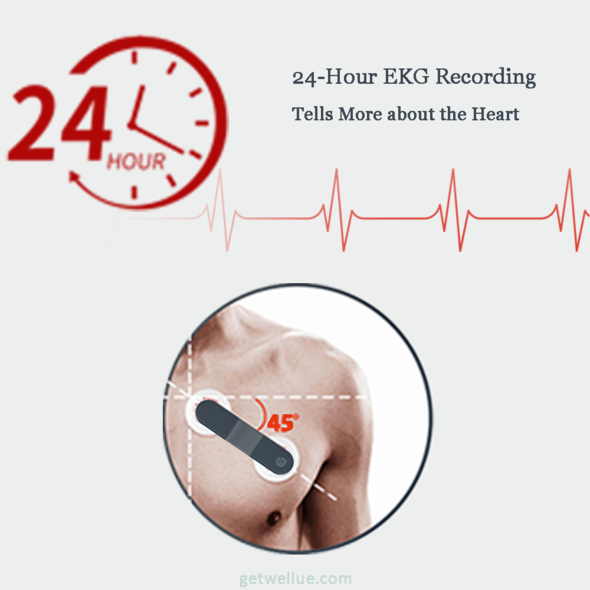
Monitor Effects of Treatments — Wearing a monitor recording 24-hour EKG may tell your doctor
– If your medicines are working.
– If a pacemaker or an implantable cardioverter-defibrillator(ICD) is working properly.
We are dedicated to developing products with medical-grade accuracy but consumer friendly, finding an easier and more modern way to track your wellness, we believe you can get peace of mind to live a healthier and longer life.
Sleep apnea is a common and potentially serious sleep disorder in which your breathing is repeatedly interrupted while you sleep. If left untreated, sleep apnea can contribute to type 2 diabetes and heart disease while increasing your likelihood of stroke and heart attack.
Sleep apnea can affect toddlers, children, and adults, although some of the identifying symptoms are different depending on your age.
Here’s everything you need to know about the signs and symptoms of sleep apnea.
Signs and symptoms of sleep apnea in adults
If a number of these 13 signs describe you, then there’s a good chance you may have sleep apnea.
You snore loudly.
Your bed partner says that you snore and sometimes stop breathing when you sleep.
You sometimes wake up abruptly with shortness of breath.
You sometimes wake up choking or gasping.
You often wake up to use the bathroom.
You wake up with a dry mouth or sore throat.
You often wake up with a headache.
You have insomnia (difficulty staying asleep).
You have hypersomnia (excessive daytime sleepiness).
You have attention, concentration, or memory problems while awake.
You are irritable and experience mood swings.
You have risk factors for sleep apnea, such as being overweight or obese, drinking alcohol, or smoking tobacco.
You have a decreased interest in sex or are experiencing sexual dysfunction.
Signs of sleep apnea in Children
According to Johns Hopkins Medicine, 10 to 20 percent of children who snore may have sleep apnea. Overall, an estimated 3 percent of children have sleep apnea.
Many children with untreated sleep apnea have behavioral, adaptive, and learning issues that are similar to the symptoms of ADHD:
difficulty with learning
poor attention span
poor performance at school
Look for these warning signs of sleep apnea in your child:
snoring
mouth breathing (while asleep and awake)
breathing pauses during sleep
bedwetting
daytime sleepiness
Signs of sleep apnea in toddlers
If you think your toddler may have a sleep disorder, look for these warning signs of sleep apnea while they’re sleeping:
snoring and difficulty breathing
pauses in breathing
restlessness
coughing or choking
sweating profusely
You can also look for the following signs while they’re awake:
prone to irritability, crankiness, and frustration
falling asleep at inappropriate times
tonsil- or adenoid-related health problems
growing more slowly than they should (both height and weight)
When to see a doctor
If you have the warning signs of sleep apnea, discuss your symptoms with your doctor. They might have some advice tailored to your specific situation or they might recommend you to a sleep specialist. They can perform a sleep study, or polysomnogram, to help diagnose sleep apnea. This test monitors many things like brain waves, eye movement, breathing, and oxygen levels in the blood. Snoring and gasping sounds, as well as stopping breathing during sleep, are also measured.
If your child is showing the signs that indicate sleep apnea, discuss your concerns with your pediatrician. Following diagnosis, your pediatrician should have a number of suggestions regarding treatment. Often they will refer you to an otolaryngologist (an ear, nose, and throat specialist) to see if removing the tonsils and adenoids could solve the issue.
If you have seen signs of sleep apnea in your toddler, review your observations with your pediatrician. Their diagnosis will include the impact of your toddler’s weight and potential allergies on their sleep. After examining your toddler’s upper airway, the pediatrician might refer you to a pulmonologist (a lung specialist) or an otolaryngologist. Removing your toddler’s tonsils and adenoids could be the recommendation.
Takeaway
Sleep apnea is more common than you might think. And it’s not just limited to adults. If you, your child, or your toddler are showing the warning signs of sleep apnea, there’s a risk of serious health consequences. Make an appointment with your doctor to discuss your concerns, symptoms, and potential treatment.
We are dedicated to developing products with medical-grade accuracy but consumer friendly, finding an easier and more modern way to track your wellness, we believe you can get peace of mind to live a healthier and longer life.
One of our customers sent a review on our Wellue O2Ring Continuous Oxygen Monitor. He thought the O2Ring is a great device to look for more insights into your blood oxygen levels. Read his story with our star product:
Being a Geek often means that you are constantly looking for better numbers. Not only faster CPUs or more memory, but often you also want to track specific metrics about your health. The Apple Watch does many of those automatically, but if you are looking to see the impact of various life events on your health, you often need a more precise and specific product.
I am suffering from sleep apnea and have tried the CPAP machines, however, I was never able to sleep with such a device. The fallback plan was to use a special mouthpiece that brings my jaw forward and opens my airways. The only metric I had to go on was that it eliminated my snoring. However, I still wondered if it actually allowed me to get enough oxygen as I had no way to measure this. Until now!
The O2Ring by Wellue is an oximeter outfitted inside a ring-shaped device that you wear all night and it tracks your blood oxygen levels every second you wear the device.
Design
The unboxing experience is simple and clean. You immediately see the O2Ring that comes as a rounded display set on a rubber ring. The shape reminds me of the 80s “feeling stones” rings that could read your emotions and change colors based on it. It’s about the same size but a bit thicker.
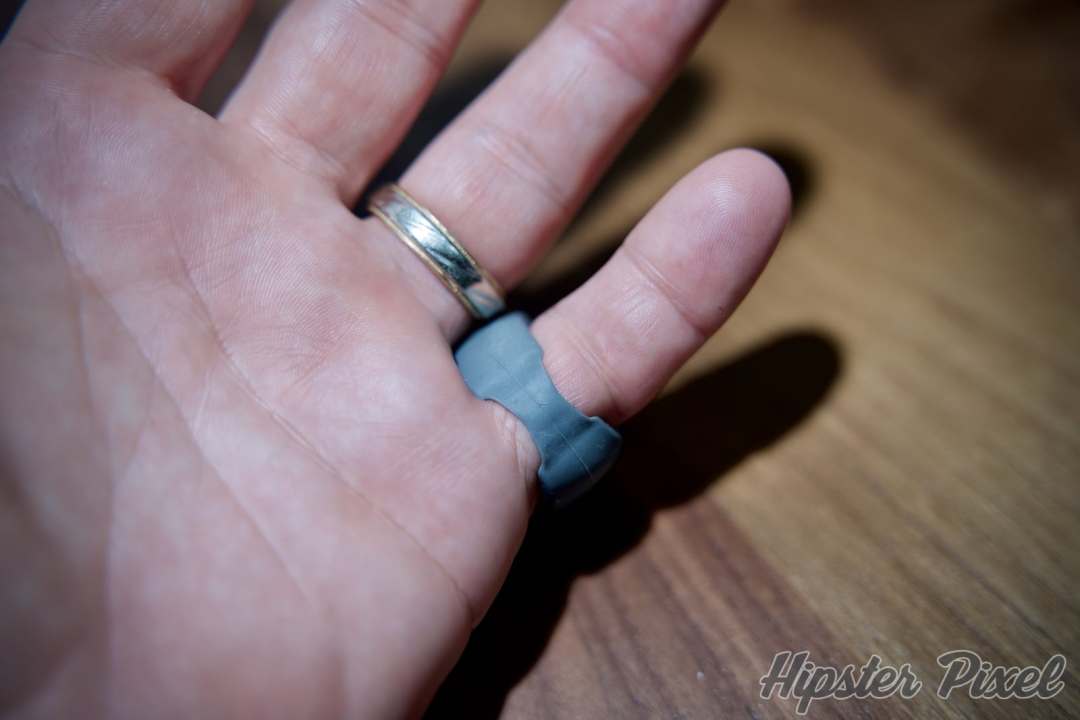
The rubber ring feels very fragile, and after trying to fit it on my thumb, I was barely able to set it there. Tried other fingers like my ring finger and it was not comfortable. It cut the circulation after a few minutes. I was suggested to use the pinky finger as any finger will work fine.
This is much more comfortable and I can wear it all night without discomfort or feeling I will break it by stretching it too much. The size of the device is not large, but sometimes it can get in the way and a few times when resetting my pillow I felt like I almost ripped it out. These times I wished it was more compact!
The display is a nice little display that displays your recorded O2 level in percent as well as your heart pulse rate. Easy to see and not disturbed during the night. You could spot some of the red light leaks around your fingers at times, but it was never enough to wake me or my wife during the night.
Features
Transmissive oximetry technology
4 second-recording intervals
4 sessions of 10 hours recording memory, unlimited datasets in app
lots of customization options
report generation, CSV, PDF and binary exports
compatible with Apple Health
FDA listed
Performance
I’ve tried it for many nights and I also tried to use it when I had a different routine to see how it would affect my oxygen level during the night. I’ve always worn my mouthpiece for sleep apnea so that I could finally know for sure if the mouthpiece worked or not.
First, let’s get this out of the way.
This is not a diagnostic tool as with all consumer oximeter, there is a ±4% accuracy buffer, so this means that if the device reports 90% you could be anywhere between 86% and 94%. You can use this information to start discussing your situation with healthcare professionals but this data should not be used as final diagnostic data to define a treatment or medication.
The device is FDA listed which means that it’s known by the FDA but not that it was tested or approved by the FDA. The manufacturer is registered and so is the device. Here’s the FDA listing for you to review. Class 2 means that devices in that category “require some regulatory control of safety and effectiveness.” This basically means that it’s a good tool, but not a medically approved diagnostic tool.
Battery Life
I put it on when I go to sleep and take it off when I get out of bed. I tried to capture more than one night on a single charge, but I was not able to complete the second night in full. They advertise up to 16h on a full charge, but I was able to get exactly 15h of recording over two nights.
Even if it dies during the night, it still keeps the partial night data and you lose nothing of what was recorded.
Data Syncing
In the morning, I would put it back on and open the iOS app to sync the data. It takes a reasonable amount of time to sync via Bluetooth all the data. About 12-15 seconds for a full night. It also syncs very short periods when I just put it on to sync the data or see my current heart rate. I usually delete those and only keep full-night data sets.
They advertise 4 groups of 10 hours, so about 40 hours of recording on the device itself, but I never reached that. I usually sync it after one or two nights. And unlimited storage inside the mobile application.
Once synced, you can see the reports and lots of interesting details like the total time < 90%, the drops over 4%, and the number of drops per recording session. You even have an O2 Score that can be an easy metric to track and see how good you were oxygenated during the night. The average heart rate will also help you to see if you are putting unnecessary strain on your body because of a sleep condition like sleep apnea. I love that you can add notes to your recording session, you can use this to note things like at what time you got to sleep, or if you have been drinking alcohol or coffee the night prior. This is helpful to track as you will forget.
Warning and Alerts
There is a feature where you can set a limit and if it is reached or passed the O2Ring will alert you and note it in the data set. This is useful if you want to be woken up by the vibration if you enter a dangerous zone. Also, if you keep the app opened, the app can also alert you audibly.
Example of a bad night
Personally, I never reached the default threshold they set at the factory. Thankfully, this means even at night where I get many O2 drops, it never drops to dangerous levels. Most probably because of my mouthpiece, though. I did not want to start snoring again so I did not stop wearing it as it will mess with my wife’s sleep.
Reporting
The reports can be exported as PDF and shared with your healthcare specialist, but at the same time it can sync your data to Apple Health. I have enabled this as I also track my blood pressure with a non-smart device where I enter my systolic, diastolic pressure and heart rate using a custom iOS Shortcut I wrote to quickly enter the data in Apple Health.
O2Ring Mobile App Report Exporting
This way I have my night oxygen level, night heart rate, resting heart rate when I take my blood pressure and my blood pressure, all in the same app. I would also recommend looking at the Heart Report app on iOS, it has very customizable report generation that can also be shared with your doctor. You can choose what metric to include to make them more useful.
Conclusion
After testing the O2Ring for many, many nights I must say that I found the experience very good! It’s not one of the most expensive ring-type devices, and it does not all the things, but it does one thing and one thing well. Its tracking is efficient and it is very simple to operate. I kind of wish it was slimmer not to get caught in my pillow or sheets while I sleep, though. And its 15-hour battery life is not enough as often, I would set it and did not realize it was not fully charged and only captured 3 or 4 hours of data.
If you are looking for more insights into your blood oxygen level, the O2Ring is a great device to do so. Its reporting is quite good, and adding notes can help you see what you change in your routine and how it affects your sleep quality. For me it was most of all a way to see if my mouthpiece was actually working for my sleep apnea and I’m happy to report it does work as on regular nights, my O2 level does not drop significantly.
There are ways to make this little device better, though! First of all, ditch the MicroUSB port for a USB-C port. Make it slimmer so it’s more of a profile design, it will probably be less in the way of sheets and pillows. And make it so that the hardware is better optimized for longer battery life! 15 hours is not enough, try to aim for at least 24h which would be about 3 nights of sleep.
We are dedicated to developing products with medical-grade accuracy but consumer friendly, finding an easier and more modern way to track your wellness, we believe you can get peace of mind to live a healthier and longer life.




 The display is a nice little display that displays your recorded O2 level in percent as well as your heart pulse rate. Easy to see and not disturbed during the night. You could spot some of the red light leaks around your fingers at times, but it was never enough to wake me or my wife during the night.
 Example of a bad night